

Koperpot
A concept website for a fictional fire-and-pot kitchen in Parkhurst, Johannesburg, built to show what a restaurant site can do when it works like the restaurant: telling you whether the kitchen is open, what is on the stove today and getting you a table in a few taps.
Most independent restaurant websites are a big food photo, a PDF menu and a phone number. They cannot tell a hungry person whether the kitchen is open right now, what is on today or whether there is a table on Friday, so people phone, or give up and go somewhere else. Restaurants also have rules to work within: the Consumer Protection Act says a displayed price must be the full price including VAT, any booking cancellation charge must be reasonable (and none applies if the guest has died or been hospitalised), and a gift voucher may not expire within three years. Liquor licensing means stating that alcohol is not sold to anyone under 18. The brief was to build a restaurant site that feels warm and sensory, does the practical work of the front of house, and looks like nothing else in our portfolio.
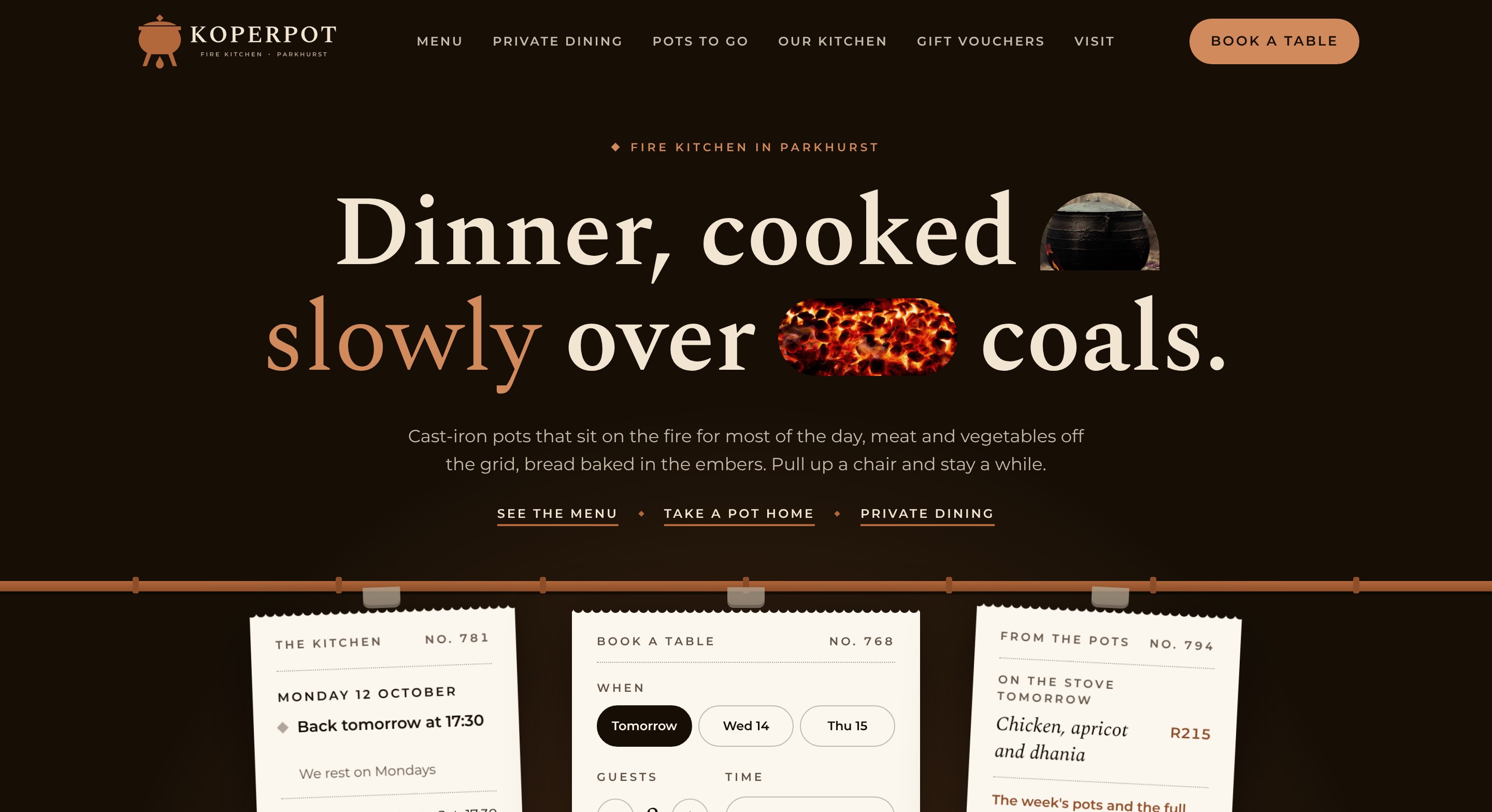
We built a fast, eleven page static Next.js site on the copper, charcoal and cream palette of the logo. The home page opens on a centred headline with the potjie and the coals set into the words, and a copper rail of kitchen dockets below it: one shows whether the kitchen is open, one books a table and one shows what is on the stove. Below that come how the kitchen cooks, the week's pots with a different pot for each day, food off the coals, private dining, gift vouchers and pots to go, a word from the chef, common questions and how to find the restaurant. The menu has a photo for every dish, dietary filters for vegetarian, vegan, gluten free and no nuts, and prices that include VAT. Booking runs in four steps with a calendar that closes on Mondays and opens for lunch on public holidays. Private dining has three spaces, set menus and an enquiry form; pots to go builds the takeaway order and previews the WhatsApp message; and the voucher builder shows the voucher as you write it. Because the restaurant is fictional, every confirmation says plainly that nothing was sent or stored. The site also includes a POPIA privacy notice, booking and voucher terms, Restaurant, Menu, FAQPage and breadcrumb schema and a full sitemap.
- Checked the roadmap name first: The Copper Pot was already in use by a guest house in Gqeberha and restaurants in other countries, so we chose Koperpot, Afrikaans for copper pot and a nod to potjiekos
- Wrote the logo prompt around a three-legged potjie with a single flame, avoiding the usual chef hats, knives and forks, then rebuilt the approved logo as clean vectors, mirrored on a centre axis so it is exactly symmetrical
- Matched the lettering to Spectral for the wordmark and Montserrat for the descriptor, and took the copper, charcoal and cream palette from the logo, adding darker and lighter coppers so every text colour passes WCAG AA contrast
- Designed a hero unlike any of our other builds: a centred headline with small photos set into it like words, and a copper rail across the full width with three kitchen order dockets hanging from it, like orders on the pass
- Made the dockets live: they read the time in Johannesburg on the visitor's device and show whether the kitchen is open, today's pot and its price, and start a booking, with the right answer on Mondays, public holidays and after closing
- Gave every dish on the menu its own photograph, and changed dishes where no honest photo could be found rather than show a picture of something else
- Built table booking that knows the opening hours, the lunch and dinner slots and South African public holidays, a private dining enquiry, a pots to go builder that writes the WhatsApp order for you and a gift voucher builder with a live preview
- Wrote all copy within the Consumer Protection Act and liquor rules: prices including VAT, plain booking and cancellation terms, three-year vouchers, an allergen note and an under-18 notice, with no invented reviews or awards
- Added metric-matched fallback fonts, security headers and branded share images, and tested every flow end to end on desktop and mobile
- Custom logo rebuilt as clean, exactly symmetrical vectors, with a full brand kit and a favicon that reads at 16 pixels
- A hero built around the restaurant rather than a template: live kitchen dockets hanging from a copper rail, with the open or closed state worked out on Johannesburg time
- A photo for every dish on the menu, with dietary filters and prices including VAT
- Table booking with opening hours, lunch and dinner services and South African public holidays, plus private dining enquiries
- A pots to go builder that writes the WhatsApp order, and a gift voucher builder with a live preview and three-year validity
- Lighthouse on mobile: 100 for accessibility, best practices and SEO on every page tested, 91 to 98 for performance, and 100 across the board on desktop
- Every booking and ordering flow tested end to end on desktop and mobile, and no horizontal scrolling on any page from 320 to 1920 pixels wide
- Pure static build with no database, so pages load fast and there is very little to maintain
The concept shows that a restaurant website can carry the warmth of the room and still do the front of house's practical work: telling people whether the kitchen is open, what is cooking today, and getting them a table, a takeaway pot or a voucher without a phone call. For a real restaurant, the same foundation can connect to its booking system and WhatsApp Business so tables and orders go straight to the team.
Want a similar outcome for your business?
Tell us where you are and we will take it from there.